People ask me this every week, usually in a worried tone. Will AI replace programmers? I write software for a living and I use coding agents every day, so here's my honest view from inside the work, not from a headline.
What AI already does well
A lot of what I used to type, I now describe. Coding agents are good at:
- Building features that follow a pattern already in the codebase.
- Writing tests, migrations, API endpoints, form validation.
- Upgrading dependencies and fixing the errors that follow.
- Explaining unfamiliar code and finding where something is used.
- First drafts of almost anything.
That's a big chunk of a typical developer's week. Pretending otherwise doesn't help anyone.
What it doesn't do
The parts that still need a person are the parts that were always the hard parts:
- Deciding what to build. A client says "we need an app". Turning that into the right system, with the right trade-offs for their budget and team, is judgment.
- Knowing when the code is wrong in a way tests don't catch. A query that works on 100 rows and falls over at 100,000. A permission check that's technically there but in the wrong place.
- Owning the result. When a payment fails at 2 a.m., someone has to understand the system well enough to fix it.
- Talking to people. Clients, stakeholders, users. Most project failures are communication failures.
Agents are improving at all of this, but they still need someone to set direction and catch mistakes.
So what actually changes?
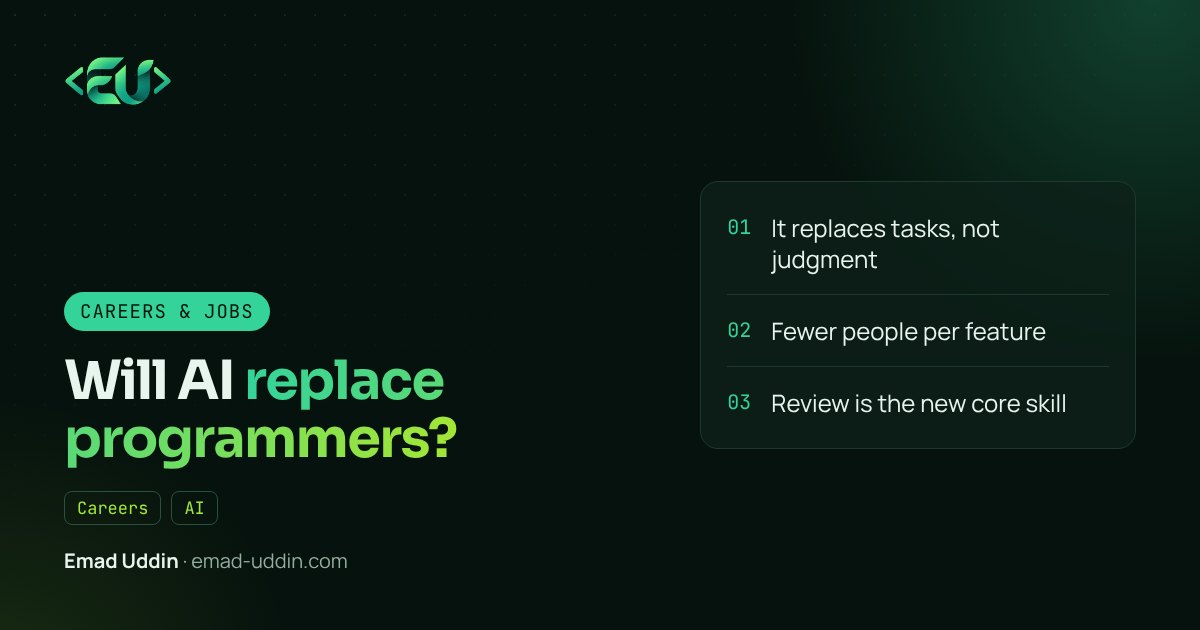
Fewer people per feature. A small team with good agents can ship what used to need a bigger one. That's the real effect on jobs, and it's why hiring has slowed in some places even as software demand grows.
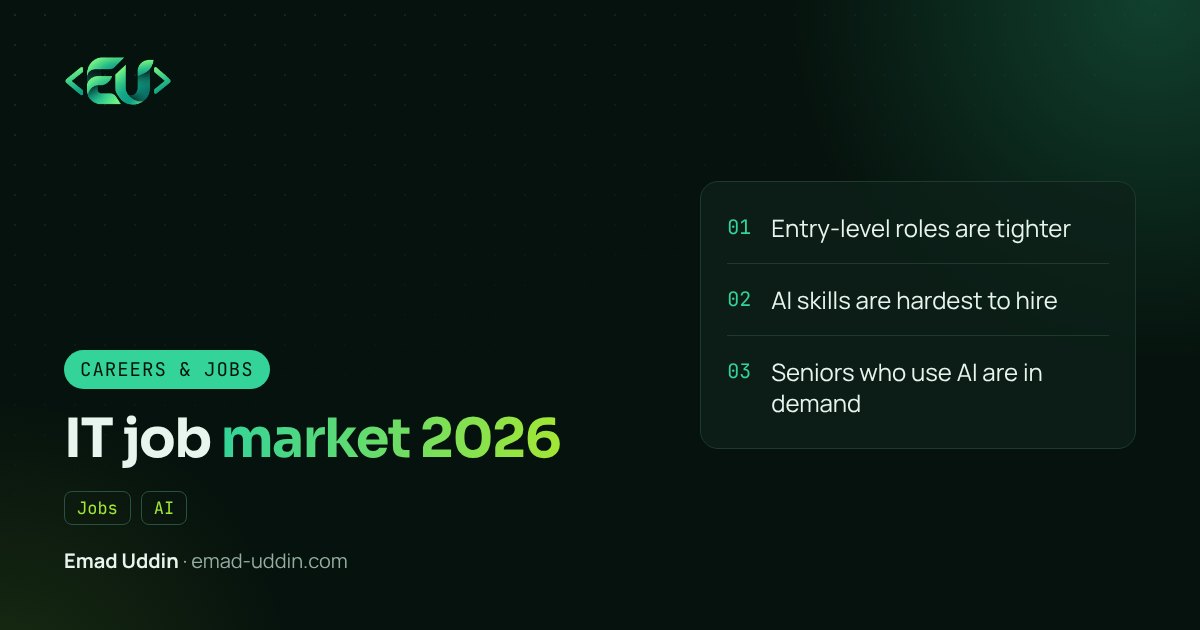
Entry-level work is hit first. Research from the Stanford Digital Economy Lab found a 13% relative drop in employment for 22 to 25 year olds in the most AI-exposed jobs, including software development, while experienced workers in the same jobs were stable. (summary) I wrote more about this in my post on the IT job market in 2026.
Review becomes the core skill. I spend more time reading code than writing it. Spotting what's subtly wrong in a 400-line diff is harder than writing 40 lines yourself, and it's where experience pays.
The job moves up a level. Less "implement this ticket", more "design this, split it into tasks, direct the agents, verify the result, talk to the client".
How I'm adapting
I've stopped selling myself on languages and frameworks and started selling outcomes: an email agent that answers routine support, a platform that replaced five separate tools. The code is still mine to own. The way I produce it changed.
The biggest change for me: a year ago I spent most of the day writing code. Now more of it goes into planning tasks and reviewing diffs, and I take on work I used to turn down for lack of time.
What I'd tell a developer who's worried
- Learn to work with agents now, while it's still an advantage and not a baseline.
- Get very good at reading code critically.
- Go deeper on one domain (e-commerce, healthcare, finance, logistics). Domain knowledge is hard to automate.
- Build things people use, and show them.
- Don't skip the fundamentals. You can't review what you don't understand.
AI won't replace the people who decide what software should do and make sure it does it. It will make each of them able to do a lot more, and that's where the opportunity is.
FAQ
Will AI replace junior developers? It's reducing junior hiring. Juniors with real AI-assisted projects and solid fundamentals still get hired.
What programming skills will still matter? System design, debugging, code review, security, understanding requirements and communication.
Should I still learn to code in 2026? Yes. You can't direct or review an agent well without understanding code.
If you're a business wondering what AI can realistically do for your team, I'm happy to talk it through. See my AI automation services.