I've been job hunting and client hunting myself this year, so the IT job market in 2026 isn't an abstract topic for me. I've seen the same pattern from both sides: fewer replies for generic "full-stack developer" applications, and a lot more interest the moment AI automation is part of the pitch.
Here's what the data actually says, and what I think it means for developers.
What's shrinking
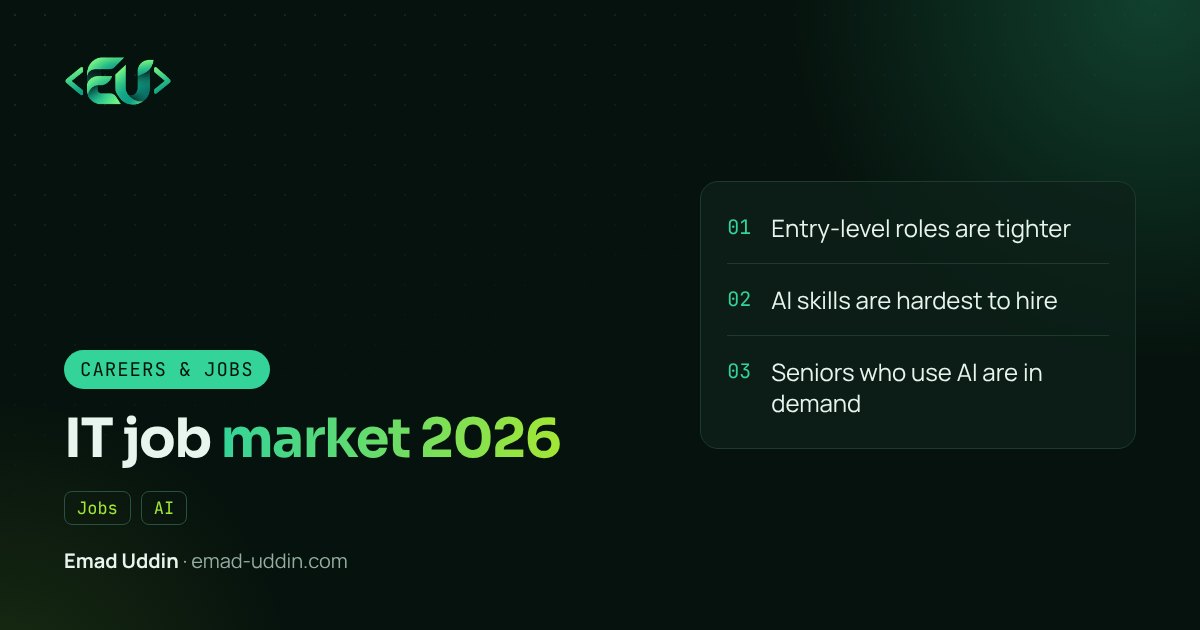
The clearest signal is at the entry level. Researchers at the Stanford Digital Economy Lab (Brynjolfsson, Chandar and Chen) looked at payroll data from ADP covering millions of US workers. They found a 13% relative decline in employment for 22 to 25 year olds in the jobs most exposed to AI, which includes software developers. Employment for more experienced people in the same jobs stayed stable or grew. (The Register's summary)
That matches what I see. The tasks juniors used to learn on (CRUD screens, simple bug fixes, writing tests) are exactly the tasks AI agents now do well. Companies are hiring fewer people to do them.
Layoffs haven't stopped either. Large companies keep cutting in some teams while spending heavily on AI infrastructure. Both things happen at once, sometimes in the same company in the same quarter.
What's growing
On the other side, demand for AI skills is the strongest it's been. ManpowerGroup's 2026 Talent Shortage Survey asked 39,063 employers in 41 countries what was hardest to hire for. AI skills came first for the first time, ahead of engineering and traditional IT. 72% of employers said they were struggling to find the talent they need. (ManpowerGroup, February 2026)
LinkedIn's 2026 "Jobs on the Rise" lists put AI engineer at number one in several countries, including Australia. (HR Leader)
The roles I see clients asking for most:
- Developers who can build AI features into real products (chat, search over company documents, automation).
- People who can design and run AI agents safely, with approvals and monitoring.
- Automation specialists who connect AI to the tools a business already uses: email, CRM, Shopify, spreadsheets.
- Security and data people, because every AI system needs both.
What it means if you're a developer
The middle is getting squeezed. "I know Laravel and Vue" used to be enough to get interviews. Now it's the baseline, and an agent can produce a lot of that code. What stands out is the layer on top: understanding a business problem, designing a system, and using AI to deliver it faster.
Experience is worth more, not less. Reviewing AI-written code, spotting the subtle bug, knowing which architecture won't hurt in a year. Those come from having built and broken things. That's why experienced developers are doing better in this market than juniors.
Proof beats claims. Every CV now says "AI". The people getting calls can point to something working: an agent that answers support email, an automation that saves hours, a public repo.
What I'm doing about it
I'm not dropping full-stack work. Most AI projects are 80% normal software: APIs, databases, auth, a frontend, deployment. What I changed is how I present it. I lead with AI automation and agents, and I show the projects where I've built them, like the email agent at MonsterClaw and the social media automation I'm building.
Since I changed my CV and profiles to lead with AI automation, the conversations are different. People come with a business problem instead of a list of frameworks, and the projects are bigger.
If you're starting out
- Build two or three small, real AI projects and deploy them. A working demo beats a certificate.
- Learn to work with coding agents, and learn to review their output critically. That's a skill employers can test.
- Pick a niche where AI meets something you already know: e-commerce, healthcare, education, local businesses.
- Write about what you build. It's how people find you.
FAQ
Is it still worth becoming a software developer in 2026? Yes, but the entry point has moved. Juniors need to show they can build real things with AI tools.
Which IT jobs are growing in 2026? AI engineers, people who build and run AI agents, AI automation specialists, and the security and data work around them.
Are tech layoffs still happening? Yes. Companies cut in some teams while hiring for AI in others.
If your business needs someone who can build with AI rather than talk about it, here's what I do.